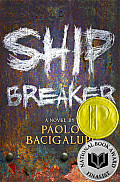
ISBN: 9780316056212
New York: Little, Brown Books for Young Readers, 2010
New York: Little, Brown Books for Young Readers, 2010
Plot - Nailer lives without knowing what the next day may bring, except more scrapping, digging, pulling, and climbing through gigantic wrecked oil tankers looking for scraps of metal or oil. His world is a post-apocolyptic U.S. Gulf Coast beach where people scrape by, quite literally, working for corrupt bosses who pay them a pittance for collecting metal that they then sell. Adults are every bit as vulnerable as the children who surround them, and so there is no protected status for children--they compete viciously among themselves and can be thrown out of a work group for not meeting quota at any moment. Nailer happens to encounter two strokes of luck (good luck, bad luck, who knows?) that could change his life. First, he literally falls into a vat of oil left deep within the hull of one of the wrecked tankers he is stripping, and although he almost drowns in it, it is a huge boon. Second, after a "City Killer" hurricane tears through the beach enclave, Nailer finds a wrecked boat belonging to one of the "Swank" families he grew up watching skate across the ocean on the horizon far out at sea. The boat is full of treasures unimagined--food, gold, silver, linens, wooden furniture, and an alive girl around his age. He and his friend, Pima, embark on a mission to decide what to do with the girl, the loot, and Nailer's abusive father who finds out about both. Along the way, Nailer's deepest human nature is exposed and tested, as he must make ethical decisions in a ultimately amoral landscape.
Critical Evaluation - Ship Breaker is a fantastic book, balancing beautiful writing, exquisite character formation, and a vividly portrayed distopian world. The world Nailer inhabits, including his daily life, is not far from today's reality for many impoverished children all over the world, and so while the reader is drawn by the heartstrings to admire and even love Nailer, we are also reminded that he is not so fictional after all. The tone of the story is edgy; Bacigalupi manages to keep the reader feeling as unsettled and uncomfortable as Nailer and those who live around him. The action moves at a good pace, never rushing through a scene simply to move on, but always going forward in an exciting way. Through it all, ethical questions run deep without ever being presented as assignments.
Reader's annotation -What happens with a boy who has to scrape and dig for bits of metal stuck inside the hulls of wrecked oil tankers just to survive suddenly finds a small, wrecked boat filled with riches? And what happens when the daughter of the boat's owner is still alive to claim what is rightfully hers?
Information about the author - According to a Wired interview from 2008, Paulo Bacigalupi grew up as the child of hippies who had moved to a very remote area of western Colorado where they attempted to grow an organic apple orchard. Bacigalupi went to college at Oberlin college where he studied Chinese and Asian world studies. He has spent time living, working, and studying in Southeast Asia, particularly in China. One of the most striking stories he tells is of the time when out of absolutely nowhere Harlan Ellison, the Hugo Award-winning science fiction author, called him at home and began critiquing one of Bacigalupi's science fiction books, line for line. Bacigalupi reports he was stunned, took Ellison's advice to heart, and through a process of abiding by it and then rejecting it ended up finding his own niche.
Genre - YA SciFi Fantasy, YA distopian fantasy
Curriculum Ties - Upper level Ethics classes; upper level social criticism, issues of poverty and child slavery
Booktalk ideas -
Genre - YA SciFi Fantasy, YA distopian fantasy
Curriculum Ties - Upper level Ethics classes; upper level social criticism, issues of poverty and child slavery
Booktalk ideas -
- Read the section where Nailer falls into the oil holding. Begin on pg. 25 with "This wasn't some giant oil tank," and end with on pg. 26, "...just some stupid room full of pooled waste."
- Read the section where Pima and Nailer first find Lucky Girl. Begin on pg. 91 with "As one, he and Pima crawled across the wreckage to the broken body" and end on pg. 93 with "The girls eyes blinked."
Reading level - YA, 13+. However, the violence, especially from father to son, is wrenching. Be careful advising this book for younger readers. My suggestion would be to aim it fully at the YA audience, at least 15+.
Challenge issues - possible challenges due to language, violence, and abusive, drug-addicted father
Challenge defense ideas:
- Librarian must read the book carefully and include it as a resource intended for older teens.
- Librarian greets students and regularly discusses their reading choices; she provides individualized, age-appropriate guidance in book choice.
- Explain the ways in which the librarian accompanies and guides younger students looking for books, and knows students well as individuals.
Why I included this book - Ship Breaker was a Michael L. Printz Award winner for 2011 and also a National Book Award finalist. This is Bacigalupi's first YA novel, and I have included it because of the quality of writing overall, including character development, style, and setting, and because of the larger ethical questions it raises about our own world. Never preaching, the story manages to force us to encounter our status as the "haves" and to consider the "have nots" with more empathy than we may ever have done before.

No comments:
Post a Comment